

Why UPPF Chooses Lubrizol TPU- and why it matters
What Separates a Great PPF from an Average One?
Walk into any detailing studio today and the shelves are stacked with paint protection film from dozens of brands. Many look similar on the roll. Many quote similar spec sheets. But after two years on a car in the Middle East sun or five winters of highway gravel in North America, the differences become obvious, and nearly all of them trace back to a single component hidden inside the film.
That component is TPU: thermoplastic polyurethane. It is the core functional layer of every modern PPF, and its quality dictates everything from optical clarity and self-healing speed to yellowing resistance and long-term durability. Choosing the right TPU is the most consequential material decision a PPF manufacturer makes. UPPF made that decision early, and chose Lubrizol.
Anatomy of a Paint Protection Film
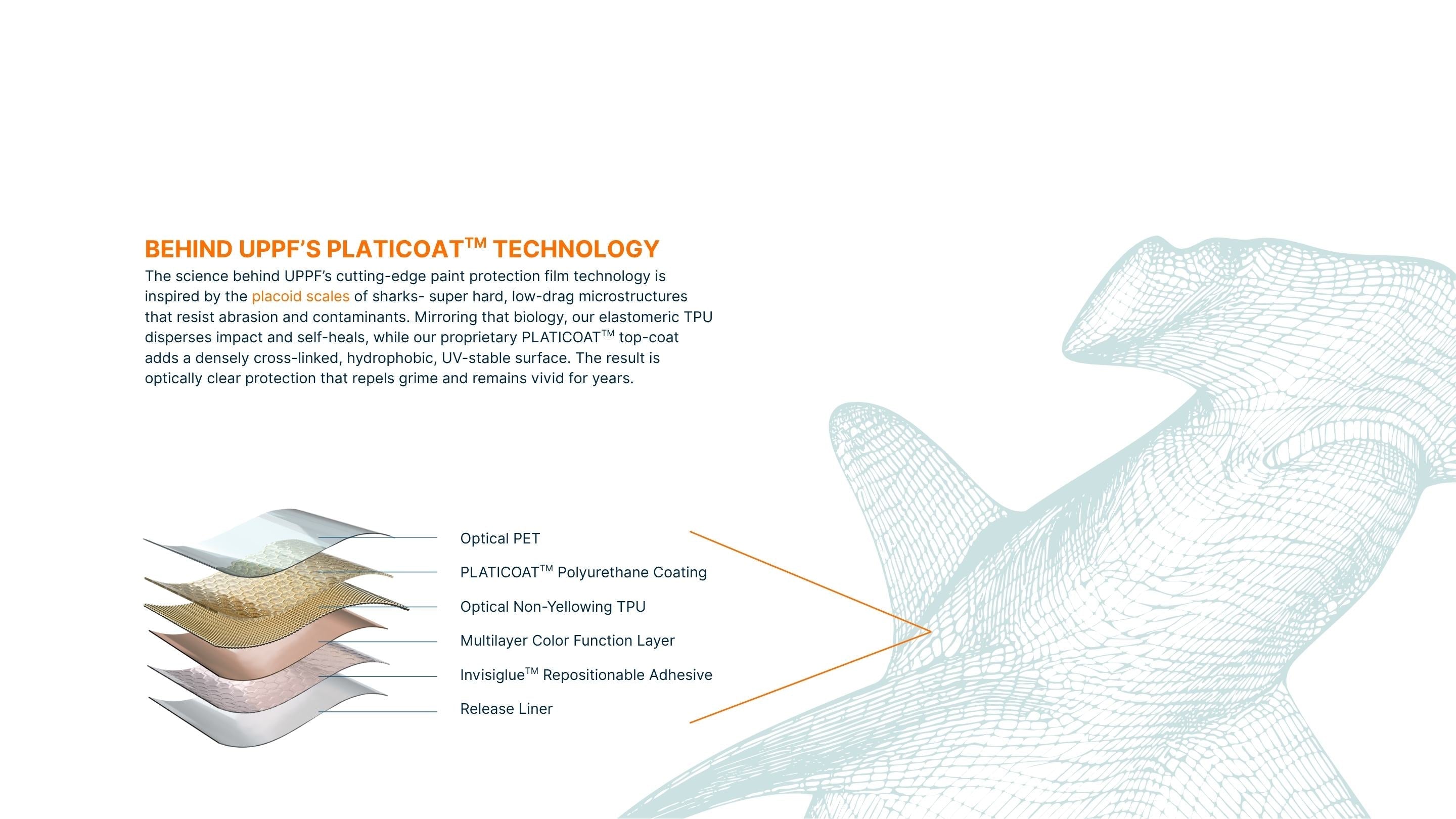
A finished PPF is a precision-engineered multi-layer laminate. Each layer serves a distinct purpose:
| Layer | Material | Function |
|---|---|---|
| Topcoat | Cross-linked polyurethane clear coat | Self-healing, stain resistance, hydrophobicity, UV stability |
| TPU Base Film | Thermoplastic polyurethane (the core) | Impact absorption, elasticity, optical clarity, anti-yellowing |
| Adhesive | Acrylic pressure-sensitive adhesive | Bonds film to paint; must allow clean removability years later |
| Release Liner | PET carrier film | Protects adhesive during storage and installation; discarded on application |
The topcoat is what installers and car owners interact with day-to-day: it heals scratches, repels water, and resists staining. But the topcoat sits on top of the foundational TPU base layer beneath it. The TPU base film is the structural heart of the PPF. It absorbs stone impacts, stretches over compound curves during installation without tearing, maintains crystal-clear optics over years of UV exposure, and provides the elastic "memory" that enables self-healing.
In short: the topcoat is what you touch. The TPU is what does the heavy lifting.
The Chemistry That Matters: Why Not All TPU Is Equal
TPU is synthesized from three building blocks: a diisocyanate, a long-chain polyol, and a short-chain extender. These react to form a polymer with alternating hard segments (which provide rigidity, strength, and heat resistance) and soft segments (which deliver flexibility, elasticity, and impact absorption).
The type of diisocyanate determines whether the TPU is aromatic or aliphatic - and this distinction alone separates premium PPF from budget product:
Aromatic TPU uses MDI or TDI diisocyanates. It is cheaper to produce but inherently unstable under UV light, causing the film to yellow and degrade over time.
Aliphatic TPU uses UV-stable diisocyanates such as HDI or H₁₂MDI. It resists yellowing and oxidation far more effectively, which is why every premium PPF brand specifies aliphatic TPU.
The polyol type adds another layer of differentiation:
| Polyol Type | Strengths | Weaknesses | Typical Use |
|---|---|---|---|
| Polyester | Good tear resistance, low cost | Prone to hydrolysis (cracks in humid climates) | Low-end or short-term PPF |
| Polyether | Better hydrolysis resistance than polyester | Poor thermal-oxidative stability at high temperatures | Mid-range products |
| Polycaprolactone | Excellent tensile strength, tear resistance, hydrolysis resistance, weathering stability | Higher cost | Premium PPF |
The cheapest path- aromatic diisocyanate with polyester polyol- yields a film that looks fine on Day 1 but yellows and cracks within a year or two in hot, humid environments. The premium path- aliphatic diisocyanate with polycaprolactone or high-grade polyether polyol- delivers a film that stays optically clear and mechanically sound for a decade.
This is where the choice of TPU supplier becomes critical.
Lubrizol: The Company That Invented TPU
Lubrizol did not simply enter the TPU market- it created it. Thermoplastic polyurethane was invented by Lubrizol Engineered Polymers in 1959, when the company was still known as BF Goodrich, and branded ESTANE® TPU. Over more than six decades since, Lubrizol has remained the world's oldest and largest manufacturer of TPU, with an unmatched portfolio of polymer grades, global manufacturing footprint, and deep application science expertise.
Key milestones and credentials include:
- 1959: Invention of TPU for commercial use, branded ESTANE®.
- 30+ years of proven, dedicated experience in PPF-grade TPU specifically.
- Global manufacturing: Production facilities in Brecksville, Ohio (USA); Montmeló, Spain; and Shanghai, China -with a new Shanghai ESTANE TPU production line launched in 2025 specifically for the Asia-Pacific PPF market.
- High-Performance Films Innovation Center: Established in partnership with research institutions and industry organizations to accelerate next-generation film innovation.
- Made With ESTANE® TPU co-branding program: Launched in 2019, this quality assurance initiative allows verified PPF manufacturers to carry the ESTANE brand mark on their products — but only after Lubrizol tests and approves that the film contains 100% genuine ESTANE TPU.
- ESTANE TPU Empowerment Ecosystem: Announced in 2024, a deeper collaboration framework giving qualified partners access to Lubrizol's polymer science expertise, market insights, and material traceability.
- Berkshire Hathaway ownership: Lubrizol is a subsidiary of Berkshire Hathaway, one of the world's most respected conglomerates, underscoring its financial stability and long-term commitment to innovation.
Lubrizol's ESTANE® TPU is recognized across the PPF industry as the benchmark polymer. Its aliphatic grades deliver the strongest anti-yellowing performance, superior chemical resistance to acid rain, bird droppings, and tree sap, the best self-healing response among major TPU platforms, and reliable flexibility across extreme temperature ranges.
Why UPPF Chose Lubrizol
UPPF's Hammerhead and Cobia PPF are engineered with an enhanced Lubrizol TPU base layer. This is not a vague marketing claim- it is a deliberate material sourcing decision that shapes every aspect of film performance:
- Optical clarity: ESTANE® aliphatic TPU produces a crystal-clear base that appears nearly invisible on the vehicle surface, preserving the depth and color of OEM paint.
- Non-yellowing longevity: Lubrizol's color-stable aliphatic chemistry resists UV-induced yellowing and oxidation, keeping the film clear on white, silver, and light-colored vehicles for years.
- Self-healing foundation: The elastic memory inherent in high-grade ESTANE TPU enables UPPF's proprietary Platicoat™ topcoat to heal fine swirls and scratches rapidly with heat or sunlight.
- Impact absorption: The TPU base disperses the energy of stone chips, road debris, and abrasion- the "predator-grade protection" that UPPF's engineering philosophy, inspired by the placoid scales of sharks, is built around.
- Installer-friendly conformability: Premium TPU stretches smoothly over complex curves, compound body lines, and deep recesses, reducing installation time and minimizing stress marks.
UPPF pairs this Lubrizol TPU base with its own proprietary technologies: Platicoat™ (a densely cross-linked, hydrophobic, UV-stable topcoat) and Invisiglue™ (a high-clarity adhesive with strong edge hold and clean removability)- to create a complete film system where every layer is optimized.
The "Golden Ratio": Tier 1 Performance at Tier 2 Prices
At UPPF, our value proposition is the "Golden Ratio": top-of-the-line protection at great value, delivering world-leading performance without excess or compromise.
This positioning is not accidental. The global PPF market is broadly segmented into tiers:
- Tier 1 brands (such as XPEL, 3M, LLumar) command premium pricing, often justified by decades of brand equity, extensive installer networks, and proprietary software ecosystems.
- Tier 2 brands offer strong products with genuine manufacturing heritage and proven distribution, but at more competitive price points.
- Budget brands- many of them newer manufacturers- compete primarily on price, often by cutting costs on the most expensive component: the TPU itself.
UPPF's strategic advantage lies in using the same premium-grade Lubrizol TPU that underpins the world's best-performing films, while leveraging our unique business model- nearly three decades of product management heritage since 1996, distribution across 85 countries- to deliver that performance at a price point that undercuts Tier 1 brands.
The result: installers and car owners get Tier 1 material science without paying the Tier 1 premium.
Why UPPF Costs More Than Most New PPF Brands
The rapid growth of the PPF market has led to an explosion of new brands, many launched within the past few years. While some of these brands produce capable products, many compete by aggressively driving down cost- and the primary lever for cost reduction is the TPU.
Here is what typically happens at the cheaper end of the market:
- Aromatic TPU instead of Aliphatic: Aromatic grades are significantly cheaper but yellow under UV exposure, especially in hot climates.
- Polyester polyol instead of Polyether or Polycaprolactone: Polyester TPU is the cheapest option but is prone to hydrolysis- the ester bonds break down in humid environments, causing cracking and clouding within 1–3 years.
- Unbranded or generic TPU resin: Rather than sourcing from established polymer houses like Lubrizol, Covestro, or Huntsman, some manufacturers use unverified domestic TPU resin with inconsistent batch quality.
- Thinner base films: Reducing TPU thickness saves material cost but directly reduces impact protection and longevity.
These cost-cutting choices are invisible at the point of sale. A cheap PPF and a premium PPF look almost identical on the roll. The difference only reveals itself over time- through yellowing, edge lifting, cracking, reduced self-healing, and premature failure.
At UPPF, our use of Lubrizol TPU underpins the price gap between UPPF and the wave of cheaper alternatives. The higher material cost is an investment in the longevity, clarity, and protective performance that car owners actually care about when the film has been on their vehicle for three, five, or ten years.
The Bottom Line
Not all PPF is created equal, and the difference starts with what is inside the film — the TPU. Lubrizol invented TPU, has manufactured it for over 65 years, and its ESTANE® brand remains the global benchmark for PPF-grade polymer performance. UPPF's decision to build its Hammerhead Series on a Lubrizol TPU foundation is a commitment to using the best available material science, ensuring that every meter of film delivers the optical clarity, self-healing capability, impact resistance, and anti-yellowing durability that car owners and professional installers demand.
That commitment is what the "Golden Ratio" means in practice: premium materials, engineered with precision, priced to deliver genuine value. It is why UPPF costs more than the cheapest options on the market, and why that price difference pays for itself on every vehicle, every year the film is on the paint.

Placoid Scales

TPU Biomimicry

Self Healing

The Engineering

The Results
Featured collection


Everything about PPF

Japan Grand Prix 2026: Antonelli's Suzuka Masterclass
On March 29, 2026, its 53-lap race delivered another chapter: 19-year-old Kimi Antonelli becoming the youngest multiple race winner and youngest championship leader in Formula 1 history.
Read moreabout Japan Grand Prix 2026: Antonelli's Suzuka Masterclass

Tokyo Auto Salon 2026 at Makuhari Messe mixed OEM concepts and grassroots creativity, with Toyota’s GR GT3 Concept taking top honors amid renewed energy for tuning, materials innovation, and high-fitment EV conversions.

Budapest–Bamako Rally 2025 celebrated its 20th anniversary with a classic route from Hungary to Gambia, unpredictable desert drama, and another win for the seasoned Koros Auto Team. Organizers balanced tradition and adaptation on Africa’s toughest amateur stage.
